Airline disruptions are often viewed primarily as operational events: delays, cancellations, missed connections, oversold flights, crew and aircraft constraints.
The industry typically responds by focusing on operational recovery:
- rerouting aircraft,
- managing airport resources,
- adjusting schedules,
- and restoring network stability.
But operational recovery is only part of the challenge.
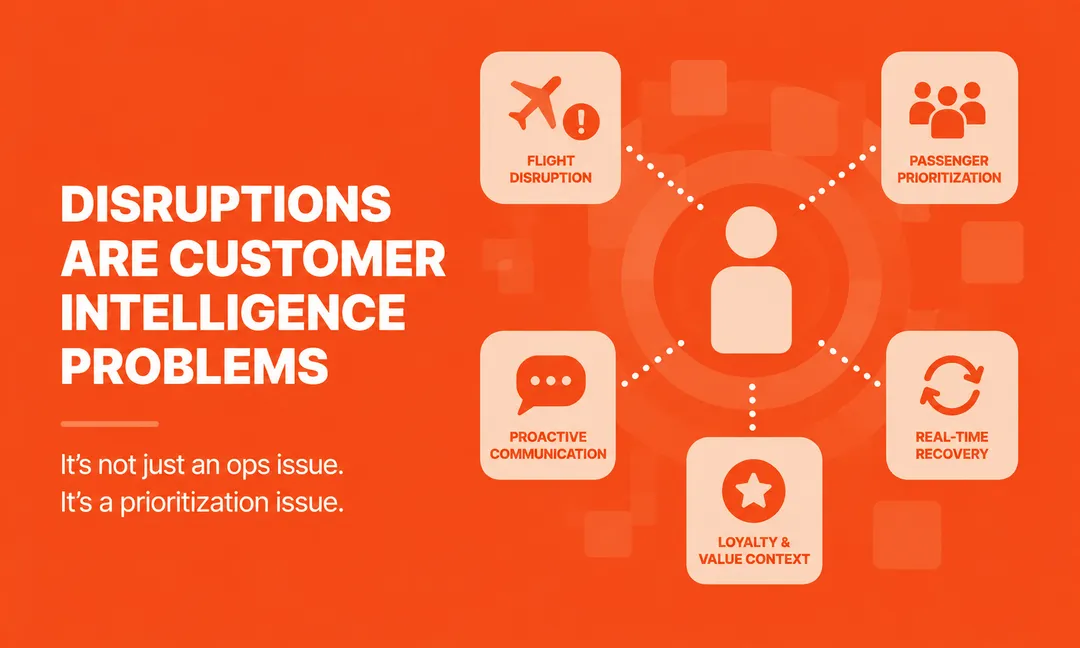
The real complexity begins when airlines must decide how to prioritize passengers during disruption. And this is where many disruption strategies fail, because irregular operations are not only operational problems. They are customer intelligence problems.
Airlines Struggle With Prioritization, Not Just Recovery
During disruptions, airlines must make thousands of decisions in real time.
Who should be rebooked first?
Who requires proactive communication?
Which passengers are most likely to miss connections?
Who should receive upgrades or recovery benefits?
Which travelers are most operationally or commercially sensitive?
These are not purely operational questions; they are customer intelligence questions.
Yet most airlines still make disruption decisions across fragmented systems:
- PSS environments,
- airport operations tools,
- loyalty platforms,
- customer service systems,
- and disconnected passenger records.
As a result, operational teams often lack a complete understanding of:
- passenger value,
- journey importance,
- loyalty relevance,
- connection risk,
- behavioral patterns,
- or real-time customer context.
This creates reactive and inconsistent disruption management.
Disruptions Expose Fragmented Customer Architecture
Under normal conditions, disconnected systems may appear manageable. But during irregular operations, fragmentation becomes immediately visible.
A passenger may simultaneously:
- contact support,
- arrive at the airport,
- receive digital notifications,
- attempt self-service rebooking,
- and interact with loyalty channels.
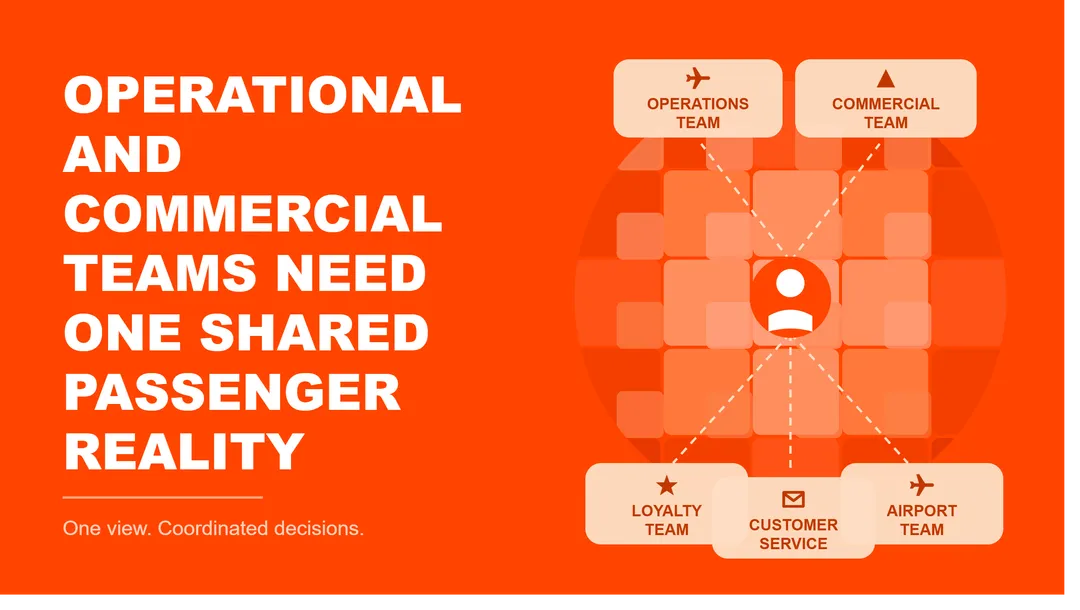
Without unified customer intelligence, every department sees a different version of the passenger.
This creates:
- inconsistent communication,
- duplicated service actions,
- delayed prioritization,
- operational inefficiency,
- and increased passenger frustration.
In many cases, airlines are not lacking operational effort; they are lacking coordinated customer visibility.
Passenger Prioritization Requires Real-Time Context
Not all passengers should be handled the same way during disruption.
A high-value connecting passenger may require:
- immediate re-accommodation,
- airport assistance,
- lounge access,
- and proactive communication simultaneously.
A passenger traveling with complex itineraries may require:
- different recovery logic,
- alternative routing priorities,
- or personalized communication timing.
A customer with repeated disruption history may require:
- proactive retention-oriented handling.
These decisions cannot be made effectively through static rules alone.
They require real-time passenger intelligence capable of evaluating:
- operational conditions,
- commercial value,
- loyalty importance,
- journey complexity,
- behavioral context,
- and recovery sensitivity simultaneously.
Without this, prioritization becomes manual, inconsistent, and difficult to scale.
Proactive Communication Depends on Customer Intelligence
One of the biggest sources of passenger frustration during disruption is uncertainty.
Passengers often receive:
- delayed notifications,
- generic messaging,
- inconsistent information,
- or no communication at all.
This significantly increases pressure on:
- contact centers,
- airport service teams,
- gate agents,
- and operational staff.
But proactive communication is not simply a messaging problem; it is a customer intelligence problem.
Airlines must understand:
- who needs communication first,
- what information is relevant,
- which channel should be used,
- and what action the passenger is most likely to take next.
Without unified passenger context, disruption communication remains reactive and generic.
Operational Excellence Requires Customer Intelligence
For years, disruption management has focused primarily on operational optimization. But modern irregular operations require something broader: coordinated customer decisioning.
This means airlines must be able to:
- identify passengers holistically,
- prioritize dynamically,
- orchestrate service actions across departments,
- and adapt recovery logic in real time.
Operational systems alone cannot solve this, because while the disruption itself is operational, the recovery experience is customer-centric.
The Future of Disruption Management Is Intelligent Passenger Orchestration
As airline operations become more complex, disruption management can no longer rely solely on operational workflows.
The airlines that succeed will be those capable of combining:
- operational awareness,
- passenger intelligence,
- behavioral context,
- and real-time decision orchestration into one connected environment.
Future disruption management will depend on:
- intelligent passenger prioritization,
- proactive communication,
- contextual recovery actions,
- and coordinated customer handling across all touchpoints.
Because during irregular operations, the problem is rarely only the disruption itself. The real challenge is knowing how to intelligently respond to every passenger affected by it.