For years, the structure of the travel industry was relatively easy to understand.
Airlines controlled inventory: seats, availability, pricing. Intermediaries controlled distribution, deciding how that inventory reached customers.
The balance of power between these two forces was stable and predictable.
Today, that balance is starting to shift. What makes this shift particularly interesting is that it’s not yet clear where power is consolidating. The signals are there (changing user behavior, new interfaces, emerging technologies), but the system itself is still in motion.
To understand what’s really happening, it helps to look not at booking, but at what happens before it.
The Journey Starts Before Search
A traveler doesn’t begin with an airline, or even with a search.
She starts with an idea. A photo, a conversation, a memory, a vague intention: “maybe I should go somewhere.”
By the time a user types a query, intent is already being formed.
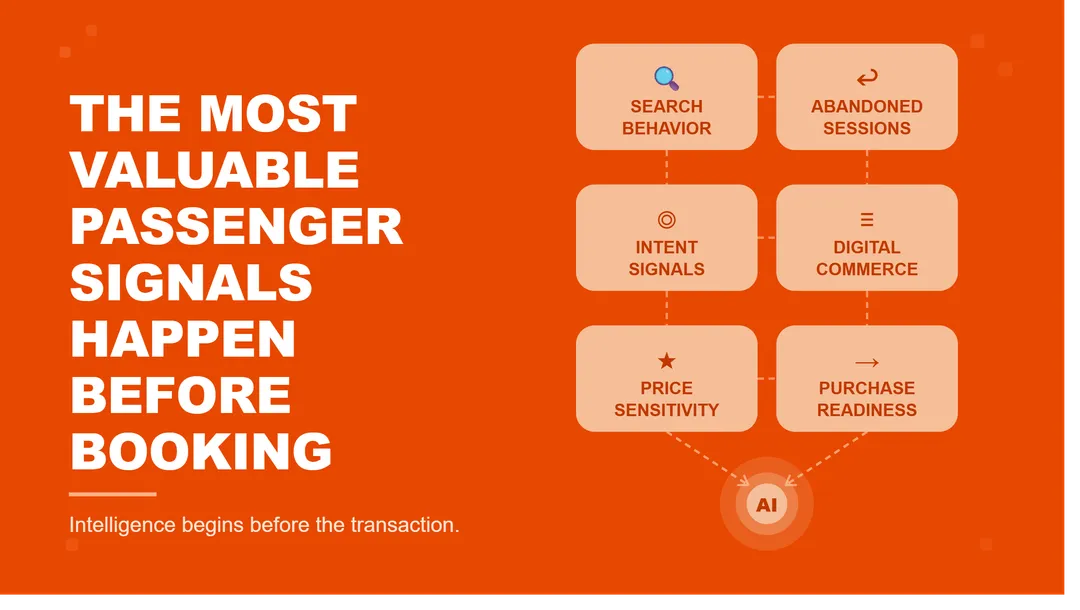
This early phase is longer and more complex than the industry often assumes. According to Expedia, in the 45 days before booking, travelers spend more than five hours engaging with travel content and visit over 140 pages on average. Many of them don’t even start with a fixed destination.
In other words, the decision-making process begins well before any platform becomes visible.
The battle does not start at booking; it starts when the trip is still a possibility.
A Journey No One Owns
The traditional funnel is a useful simplification, but it no longer reflects reality.
The modern travel journey is not linear. It is dynamic, iterative, and fragmented: users move across search engines, metasearch, OTAs, airline websites, and social platforms, often repeatedly, on different devices, in different contexts, in different moments of attention.
And this goes beyond fragmentation. The journey itself is structurally unowned.
No single player, whether airline, intermediary, or platform, controls it end-to-end. Everyone participates, but no one owns the full decision path.
The Data Paradox
Most companies in travel will say they have a lot of data, and they are right.
The industry has never had more data than it does today: behavioral signals, transactional records, customer profiles, third-party inputs.
And yet, even in large organizations, only a fraction of that data is actually used in decision-making. Estimates suggest that number is often around 40%.
This creates a paradox: data is abundant, but usable insight is scarce.
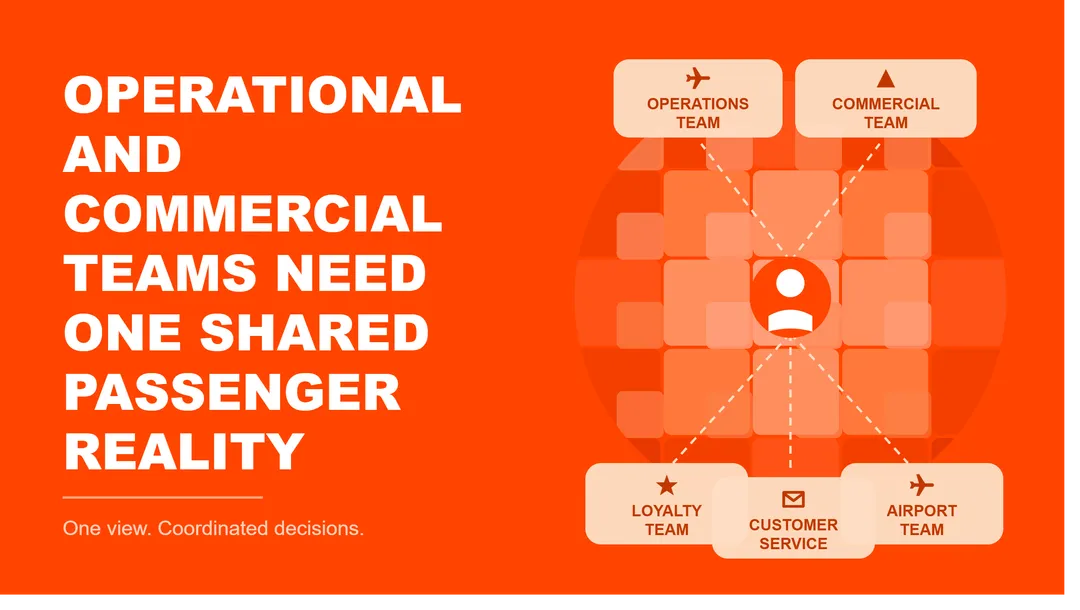
The reason is structural. Data is fragmented across systems, teams, and formats, mirroring the fragmentation of the customer journey itself. Fragmentation does not produce clarity; it produces noise.
The challenge is no longer collecting data. The challenge is turning data into decisions.
From Search to Intent
For decades, the industry has been built around search.
Users typed queries, and platforms returned ranked lists of options.
This paradigm shaped distribution models, user interfaces, and even revenue mechanics, from commissions to conversion optimization.
But this model is now evolving.
Users are no longer just searching; they are expressing intent.
“I want a weekend trip in May, not too far, with good weather and a reasonable price.”
That is not a keyword query. It is a structured intention.
And when interaction shifts from search to intent, the interface changes from lists to conversations.
More importantly, control shifts as well: away from platforms that display options, toward systems that interpret intent and make decisions.
AI, in this context, is not just another channel or interface layer.
It becomes a decision layer, positioned between the traveler and the industry itself.
Why Distribution Alone Is No Longer Enough
Distribution still matters, and channels still matter.
But distribution alone is no longer a durable competitive advantage.
Travelers operate across multiple environments. They explore, compare, and validate, often using OTAs even when they ultimately book elsewhere.
Owning a channel does not mean owning the decision, because attention, and increasingly decision-making itself, is no longer tied to a single platform.
This leads to a more fundamental risk: not losing access to the customer, but losing influence over the outcome.
The Shift Toward Decisioning
What we are observing is a structural transition in the industry:
- From controlling inventory → to influencing intent
- From controlling distribution → to enabling decisioning
- From reacting to demand → to interpreting it in real time
In this emerging model, competitive advantage will not come from having the most data, or even the widest distribution.
It will come from the ability to connect fragmented signals, understand intent, and turn that understanding into decisions, instantly and in context.
The Real Battlefield
The key battleground in travel is moving upstream, past the point of booking and even past the point of search, to the earlier stage where intent is still forming and influence is still possible.
The companies that succeed in this environment will not simply present options.
They will shape decisions.
Because the real battle in travel starts before the click.