In the airline industry, booking a ticket is rarely a single-person decision. While one individual completes the purchase, airline choice is often shaped by a wider network of influences. Corporate travel policies, agency recommendations, online platforms, and personal preferences all play a role in determining which airline is ultimately selected.
Despite this reality, many airlines still design their data and engagement strategies around the direct booker alone. This approach overlooks the broader ecosystem of stakeholders who influence demand and purchasing behavior.
As a result, airlines frequently operate with an incomplete understanding of their customers. A booking may be made by a corporate travel manager or a travel agency, while the actual traveler remains only partially visible. A reservation coming through an OTA may appear disconnected from the traveler’s previous history or long-term value. A loyalty member may be recognized, but the intermediaries or influencers behind the booking remain invisible.
Over time, these gaps create fragmented customer intelligence and limit an airline’s ability to build meaningful, durable relationships.
The Hidden Influencers Behind Every Booking
Most airline bookings involve multiple roles, yet operational systems tend to capture only one at a time. A corporate trip may be booked by a travel manager, approved through procurement, influenced by colleagues, paid for by the employer, and taken by the employee. A leisure trip may be researched on an OTA, booked through a travel agent, and flown by a group of family members. Frequent business travelers often rely on assistants to handle bookings while they personally manage loyalty status and travel preferences.
When these roles are viewed in isolation, critical insight is lost. Airlines struggle to understand who truly influences airline selection, which partners drive high-value travelers, or how internal and personal networks shape travel behavior. Most importantly, they lack a consistent way to connect the booker, influencer, decision-maker, and traveler into a single customer view.
This fragmentation leads to suboptimal decisions. Airlines may prioritize booking volume over traveler lifetime value, invest heavily in intermediaries without understanding the customers behind them, and miss opportunities to engage valuable travelers who book through indirect channels.
Why Traditional Data Models Are Not Enough
In response, many airlines attempt to collect more data. More booking fields, more email addresses, more loyalty registrations. However, more data without connection often increases complexity rather than clarity. The same individual may appear under multiple identities across booking, loyalty, digital, and service systems, resulting in duplicated or incomplete profiles.
The underlying issue is structural. Traditional airline systems were designed to manage transactions, not relationships. Reservation platforms focus on bookings. Loyalty systems track mileage and status. Customer service tools log interactions. Each system works as intended, but none were built to create a unified, customer-centric view across the entire journey.
Building Unified Customer Intelligence
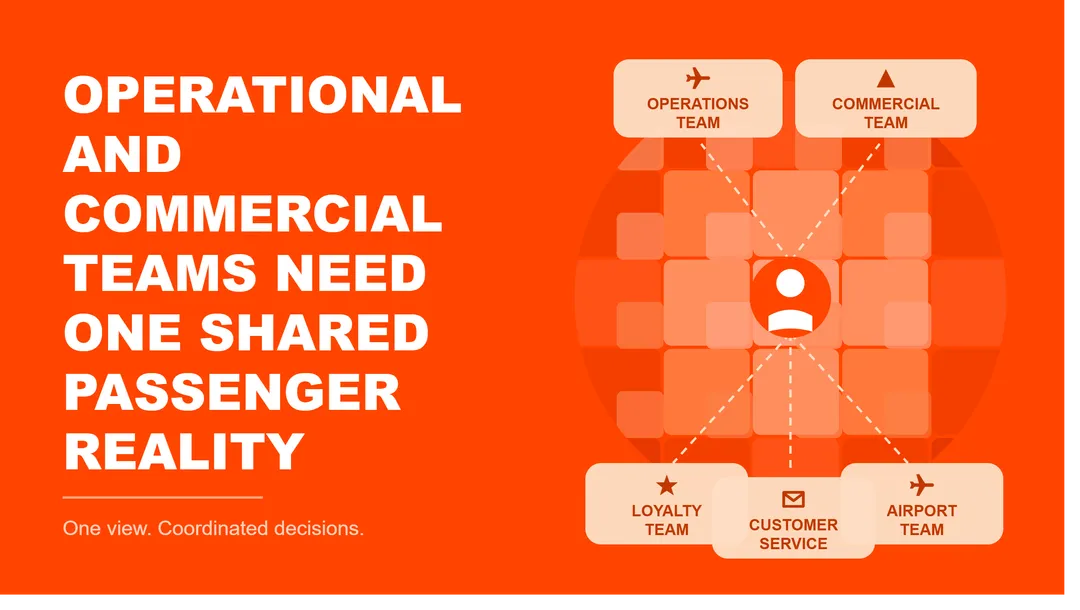
A Customer Data Platform designed specifically for airlines addresses this challenge by connecting customer interactions across channels and roles. Using privacy-compliant and consent-driven identity resolution, the CDP links bookings, loyalty activity, digital engagement, and service interactions into a single, evolving customer profile.
With this unified view, airlines gain a clearer understanding of their full customer ecosystem. High-value travelers can be identified regardless of how they book. Corporate travel behavior can be analyzed in the context of the travelers it represents. Agency and partner performance can be evaluated based on traveler value, not just transaction counts.
This foundation enables airlines to shift from channel-based marketing to relationship-based engagement. Communications become more relevant. Loyalty benefits reflect real travel behavior. Partnerships are strengthened through insight rather than assumption.
From Transactions to Relationships
By understanding the complete customer ecosystem, including travelers, bookers, influencers, and intermediaries, airlines can build stronger relationships, increase customer lifetime value, and make more informed decisions across pricing, scheduling, and product development.
The question is no longer whether airlines need a 360-degree view of their customers. The real question is how quickly they can build one and how effectively they can use it.