
Operational performance is often associated with infrastructure: aircraft, schedules, crew, airport resources, and network planning. But as airline operations become increasingly complex, another factor is becoming equally important: the speed of decision-making.
Every day, operational teams must make thousands of decisions involving:
- disruptions,
- passenger recovery,
- service coordination,
- resource allocation,
- and customer communication.
The faster these decisions are made, the faster airlines can respond. And operational speed increasingly depends on customer visibility.
Operational Delays Often Begin With Information Gaps
Airlines generate enormous amounts of customer and operational data.
Yet much of that information remains distributed across:
- PSS platforms,
- loyalty systems,
- customer service tools,
- airport systems,
- operational platforms,
- and digital channels.
When information is fragmented, teams spend valuable time searching for answers.
Questions that should take seconds often require multiple systems, departments, or manual processes.
For example:
- Which passengers should be prioritized first?
- Who is most affected by a disruption?
- Which customers require proactive communication?
- Which travelers have high commercial or loyalty value?
Without unified visibility, operational teams often spend more time gathering information than acting on it.
Faster Decisions Require Shared Passenger Context
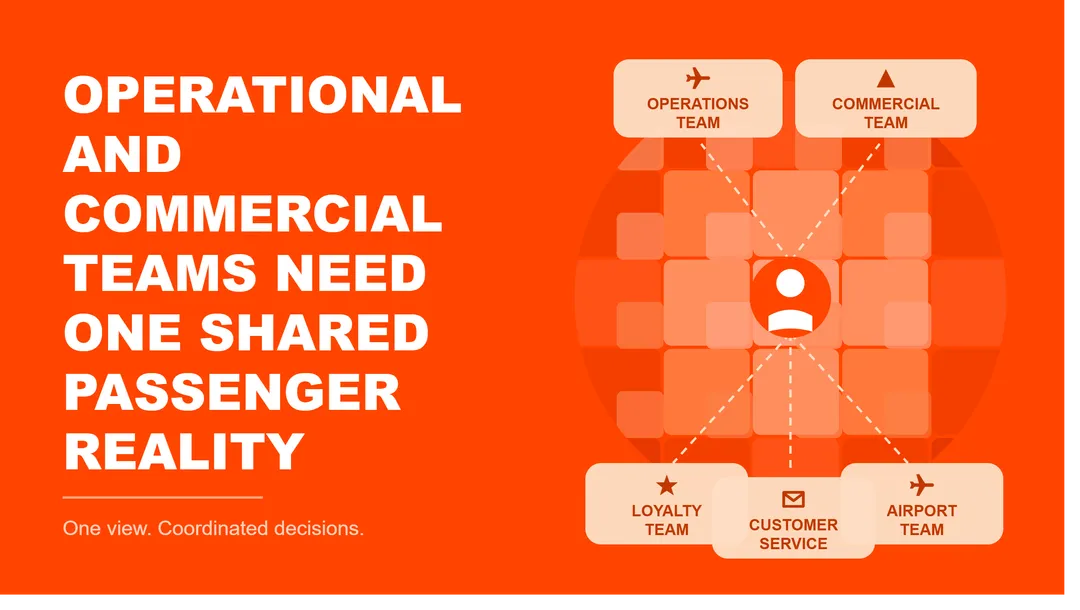
Operational efficiency is not only about automation; it is about alignment. When different departments operate from different customer realities, decision-making slows down. Airport teams see one view, customer service sees another, commercial teams see a third, and operations teams see a fourth.
This creates unnecessary coordination overhead. But when all teams work from a shared passenger intelligence environment, decisions become significantly faster.
Everyone operates from the same understanding of:
- customer value,
- journey status,
- disruption impact,
- behavioral context,
- and operational priorities.
The result is less discussion and faster action.
Real-Time Prioritization Improves Recovery Speed
During irregular operations, prioritization becomes critical, because not every passenger requires the same response.
Some customers may face:
- tight connections,
- complex itineraries,
- high-value bookings,
- loyalty obligations,
- or elevated disruption risk.
Traditional operational workflows often rely on static rules or manual intervention, but unified passenger intelligence enables real-time prioritization.
Airlines can evaluate:
- operational conditions,
- passenger value,
- journey complexity,
- and customer context simultaneously.
This allows teams to focus resources where they create the greatest impact. Recovery becomes faster, passenger experience improves, and operational pressure decreases.
Reduced Manual Coordination Creates Capacity
One of the hidden costs of fragmented customer environments is coordination effort.
Teams spend significant time:
- validating information,
- transferring cases,
- reconciling passenger records,
- and confirming priorities.
These activities add little value to the customer, but they consume operational capacity. Unified passenger intelligence reduces this friction: instead of moving information between departments, airlines can move directly to action.
This creates:
- faster service delivery,
- fewer operational bottlenecks,
- improved employee productivity,
- and more scalable workflows.
Operational speed is not only about doing things faster; it is about removing unnecessary work entirely.
Customer Intelligence Is Becoming Operational Infrastructure
Historically, customer intelligence was viewed primarily as a commercial capability, something used for:
- marketing,
- loyalty,
- personalization,
- and revenue optimization.
But that perspective is changing. Today, customer intelligence is becoming operational infrastructure.
It helps airlines:
- coordinate recovery actions,
- prioritize passengers,
- align departments,
- automate decisions,
- and improve execution speed across the organization.
The same passenger intelligence that improves customer experience can also improve operational performance.
The Future of Airline Operations Is Connected Decision-Making
As airline environments become more dynamic, operational success will depend less on isolated systems and more on connected intelligence.
The airlines that respond fastest will not necessarily be those with the largest teams but those with the clearest visibility.
Future operational excellence will depend on:
- unified passenger intelligence,
- real-time decision support,
- shared customer context,
- and coordinated action across departments.
Because operational speed is not created by moving faster; it is created by understanding faster. And customer intelligence is becoming one of the most powerful operational accelerators available to airlines today.