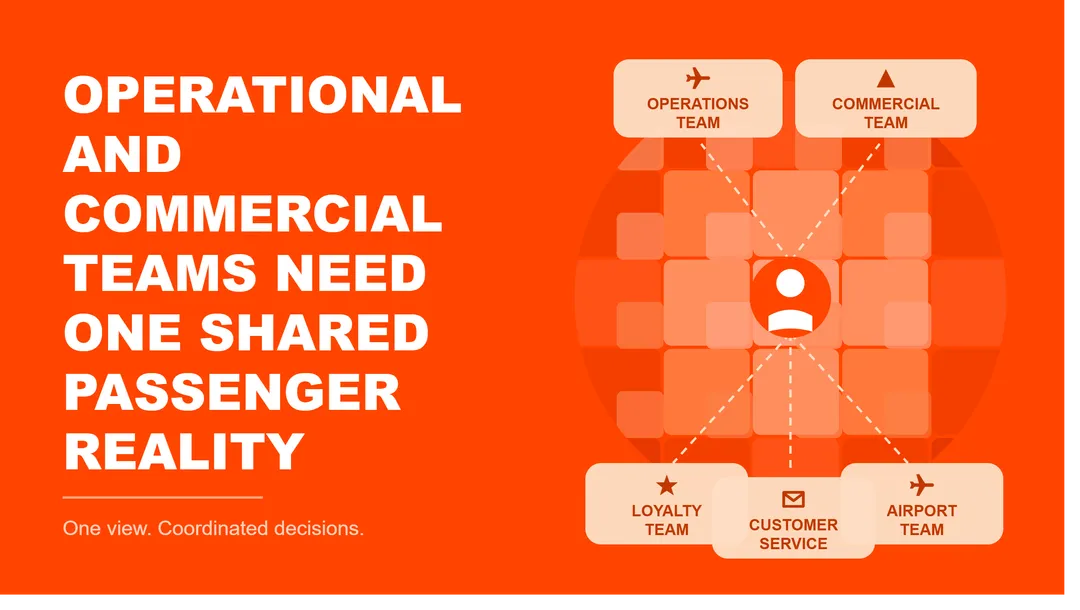
Every airline is built around specialized teams. Operations manage flights, commercial teams optimize revenue, loyalty teams strengthen customer relationships, airport teams coordinate the passenger experience, and customer service resolves issues.
Each team performs a different role, but every team ultimately serves the same passenger. The opportunity is ensuring they all understand that passenger in the same way.
One Passenger, One Shared Understanding
Modern airlines operate through dozens of platforms. Each system provides valuable information, but that information often remains tied to individual departments. Operations may understand the current journey, commercial teams may understand purchasing behavior, loyalty teams recognize customer value, and airport teams focus on real-time execution.
Each perspective is useful, but none tells the complete story on its own. The next step is creating a shared passenger understanding that connects every function across the organization.
Customer Intelligence Becomes Enterprise Intelligence
Customer intelligence is no longer only a marketing capability; it is becoming an enterprise-wide decision layer. When operational, commercial, loyalty, and airport teams access the same customer context, they make decisions that naturally complement one another.
Instead of optimizing isolated moments, airlines optimize the entire journey, and passenger understanding becomes a shared organizational capability rather than a departmental asset.
Orchestration Creates Better Decisions
The value of connected intelligence is not simply visibility; it is coordination. Modern airline organizations increasingly need systems that orchestrate customer interactions across every department.
Instead of separate decisions, airlines can coordinate:
- operational recovery,
- customer communication,
- ancillary recommendations,
- loyalty recognition,
- airport service,
- and digital engagement.
Every action becomes part of one continuous passenger experience.
Alignment Creates Operational And Commercial Value
Unified intelligence benefits more than customer experience; it improves organizational performance. Teams spend less time reconciling information, manual coordination decreases, and decision-making accelerates. Commercial opportunities become more relevant, and operational responses become more personalized.
The same customer understanding creates value across multiple business functions simultaneously.
Passenger Experience Is An Organizational Outcome
Passengers do not experience departments; they experience one airline. They do not distinguish between operations, airport services, marketing, loyalty, and customer support. For the passenger, every interaction contributes to one continuous experience.
That experience is strongest when every team works from the same understanding of the customer.
The Future Of Airlines Is Connected Intelligence
The next generation of airline organizations will not be defined by individual systems but by how effectively those systems work together.
The airlines that succeed will be those capable of:
- orchestrating customer intelligence across departments,
- aligning operational and commercial priorities,
- enabling coordinated decision-making,
- and delivering one connected customer experience.
Because transformation is not only about connecting technology; it is about connecting the people who serve the passenger.